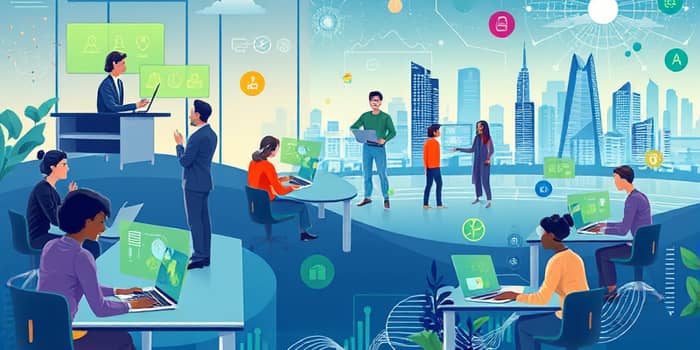
The world of work is undergoing a seismic transformation, driven by technology, shifting preferences, and an urgent need for sustainability. As organizations adapt, understanding these changes becomes critical for policymakers, business leaders, and employees alike.
From the rise of remote collaboration to AI-powered decision-making, this article explores the key trends reshaping labor markets, examines challenges in culture and connection, and highlights opportunities for resilience and green growth.
Hybrid and remote work models have moved from niche experiments to mainstream practice. In 2025, 22 percent of the U.S. workforce operates remotely, and 83 percent of global workers report a preference for flexible arrangements.
Major urban centers like New York, Minnesota, and Massachusetts see hybrid roles accounting for nearly one-third of job postings. Only 19 percent of candidates now seek full-time office positions, marking a cultural shift in expectations.
Studies indicate a 35-40 percent productivity boost among remote employees, fueled by fewer distractions and custom work environments. Mental health metrics improve with reduced commute stress, and absenteeism declines as work-life boundaries become more balanced.
On the environmental side, remote work cuts carbon emissions by reducing daily commutes. Organizations are designing both physical and virtual spaces with environmental sustainability and collective ambition in mind.
AI and automation are reshaping workflows across industries. By 2030, 60 percent of firms expect digital innovation to transform business models, with 86 percent already investing heavily in AI-driven analytics.
Human-AI partnerships free talent from repetitive tasks, enabling focus on strategic, high-value work. Yet, ethical considerations arise around data privacy and algorithmic bias, demanding transparent policies for ethical AI use and inclusive design.
The skills landscape is evolving rapidly. Demand for AI, big data, and cybersecurity expertise soars, while manual dexterity roles face a projected decline. Organizations must invest in structured reskilling and upskilling programs to close gaps and foster adaptability.
Employees increasingly prioritize purpose-driven work and psychological safety. Progressive companies embed neuroinclusion practices, address gender and generational equity, and champion meaningful employee engagement and inclusion.
Generations differ: Gen Z shows the lowest appetite for full-remote roles (23 percent), while Millennials and Gen X hover around 35 percent. Tailoring policies to diverse preferences enhances retention and innovation.
Flexible models can fragment teams. With 70 percent of job seekers demanding hybrid options, organizations face the task of maintaining cohesion. Success hinges on clear goals, regular in-person touchpoints, and robust digital collaboration tools.
Global talent pools are now accessible, allowing companies to hire specialists regardless of location. This diversity of thought fosters creative solutions and drives innovation across markets.
Organizations adopting continuous, agile response to market changes build resilience against economic shocks. Moreover, the green economy presents growth avenues in energy storage, sustainable logistics, and clean technology.
Leaders blend human judgment with AI insights to navigate complexity. The concept of AI-powered leadership combining human insight with advanced analytics is gaining traction, as real-time data informs strategies and operational adjustments.
Soft skills—empathy, cultural intelligence, and change management—remain paramount. Executives must foster environments where innovation thrives alongside trust and accountability.
The future of work demands a holistic approach. Employers should weave together remote flexibility, technological prowess, and a commitment to sustainability. By prioritizing remote and hybrid work arrangements, ethical AI deployment, and inclusive cultures, organizations will attract and retain top talent.
Economic resilience will hinge on lifelong learning, data-driven decision-making, and a steadfast focus on environmental impact. As the lines between physical and digital workspaces blur, the most successful entities will be those that foster collaboration, champion diversity, and embrace continuous transformation.
References