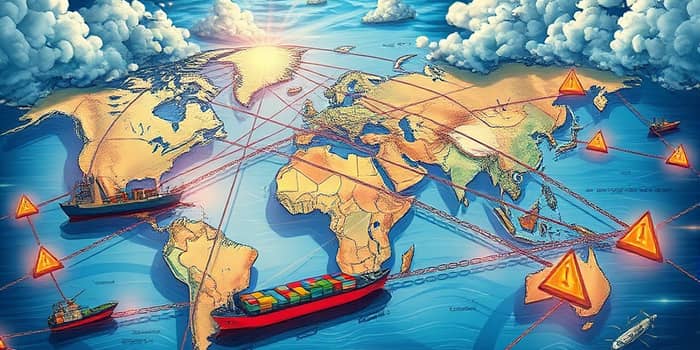
By 2025, businesses worldwide face an era of unprecedented uncertainty. This article unpacks how supply chain shocks reshape markets, industries, and strategies.
Sudden, significant disruptions in the flow of goods or information within networks are known as supply chain shocks. These events can originate from natural disasters, geopolitical conflicts, policy reversals, or cyberattacks.
Studies show that half of a disruption’s total effect on economic output often stems from amplification across complex supplier networks, magnifying the initial impact far beyond its source.
Between 2020 and 2025, multiple shocks converged, creating a perfect storm:
Geopolitical tensions and policy swings—notably U.S.-China and EU-U.K./Russia standoffs—have become central disruptors. Tariff cycles, sudden trade bans, and reciprocal measures force companies to adapt overnight.
Regulatory regimes are also in flux. Intensified environmental, labor, and safety standards demand rapid compliance upgrades, increasing overhead. Meanwhile, inflation remains sticky: 56% of chief economists predict weaker global conditions in 2025, versus only 17% who foresee improvement.
Protectionist trends and reshoring ambitions pose another dilemma. While nearshoring reduces concentration risk, it may cut global GDP by over 5%, with OECD members potentially facing 3.2–13.1% losses if they over-emphasize domestic production.
Price increases and persistent inflation ripple through supply networks. Analysts attribute roughly 25% of post-2020 inflation and GDP fluctuations to external supply shocks.
Companies are pivoting from cost-minimization to resilience. Key approaches include:
Policymakers face a delicate balance. Broad tariffs and protectionist barriers can backfire, costing more in lost growth than they save in strategic autonomy. Instead, multilateral trade frameworks with targeted safeguards offer a more sustainable path.
New regulations around sustainability, ESG disclosures, and digital security are rising. Firms must invest in transparency tools and compliance programs to meet evolving standards and maintain market access.
The era of stable, cost-focused global supply chains has ended. Businesses must operate in a world where turbulence and protectionism are the norm, not the exception.
Technological advances in automation, AI, and edge computing will become vital for scenario planning and rapid response. Companies transitioning from just-in-time to just-in-case models will face higher costs but gain robustness against future shocks.
Debates will continue over the trade-offs between efficiency, resilience, and sustainability. Ultimately, the winners will be those who embrace complexity, invest in risk management, and foster cooperative international frameworks rather than retreating into isolation.
Supply chain shocks are no longer rare anomalies—they are structural features of the modern global economy. Preparing for them is not optional; it is essential to securing future growth and stability.
References