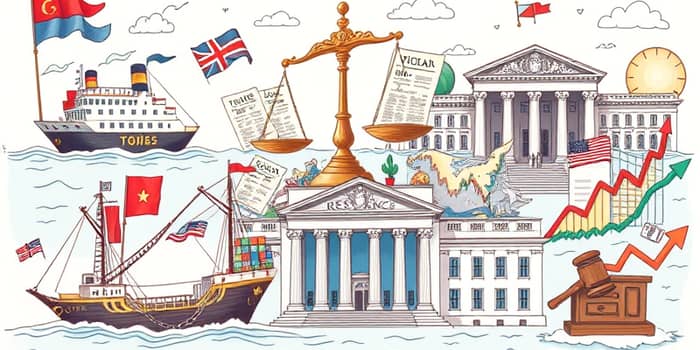
Government decisions ripple through every corner of the economy, ultimately shaping financial markets, corporate earnings, consumer behavior, and broader macroeconomic trends. From trade tariffs to fiscal stimulus and central bank maneuvers, each policy lever carries both promise and risk. Understanding these levers empowers investors, businesses, and citizens to navigate uncertainty with confidence.
Trade policy has moved to center stage in 2025, with proposals such as a potential 60% tariff on imports from China and 20% on other goods. While final rates are likely moderated, the average U.S. tariff rate has climbed to 22.5%, highest since 1909. Economists estimate that a 4 percentage point increase in the effective tariff rate would:
Mechanisms at work include higher import prices reducing consumer purchasing power, import substitution boosting domestic output marginally, and retaliation by trading partners suppressing U.S. exports. Market reactions unfolded dramatically: the S&P 500 plunged nearly 20% after new tariff announcements, then rebounded 36% by October, finishing the year up 15.1% year-to-date.
Fiscal policy debates dominate Washington, with key proposals to extend the 2017 Tax Cuts and Jobs Act (TCJA) provisions and consider deeper corporate rate cuts. Extending current cuts retains the status quo but inflates projected deficits by $7.4 trillion through 2034, adding around 10 percentage points to the debt-to-GDP ratio. Lowering the corporate rate from 21% to 15% could boost S&P 500 EPS growth by 5 points, lifting consensus from 13% to 18% in 2026.
The July 2025 “One Big Beautiful Bill Act” combines extended tax cuts with spending reductions but still expands federal debt by $3.4 trillion. While corporate earnings may gain an extra $100 billion in 2025 and households see $127 billion more in after-tax income in 2026, the tradeoff lies in higher long-term debt and potential inflationary pressures.
Regulatory shifts often occur swiftly as new agency heads are appointed. In 2025, anticipated rollbacks include pausing Basel III capital requirements, scaling back CFPB rules, and halting SEC climate disclosures. These moves can fuel rapid increases in merger activity and spur short-term market gains, particularly in financials and small caps.
However, deregulation carries the risk of heightened systemic vulnerability. Reduced oversight may encourage risk-taking and leverage accumulation, setting the stage for future regulatory backlash or financial instability. Investors need to weigh immediate profits against the possibility of sudden policy reversals that could amplify volatility.
The Federal Reserve faces a delicate balancing act: interpreting tariff-driven price pressures as transitory while prioritizing growth risks. Markets anticipate gradual 25-basis-point rate cuts through early 2026, targeting a policy rate near 3.25%. Recent 0.25% cuts in September and October 2025 underpin this dovish outlook.
Yet threats to central bank independence loom. Executive efforts to influence Fed leadership could un-anchor inflation expectations and push up long-term rates. For now, U.S. Treasuries remain a global safe haven, reflecting confidence in the country’s creditworthiness even amid fiscal debates.
Political gridlock often leads to government shutdowns, but their market impact has historically been muted. The S&P 500 typically posts an average gain of 4.4% during these episodes. Still, prolonged shutdowns can delay economic data releases, disrupt federal payment flows, and heighten uncertainty—especially if coupled with a debt ceiling standoff.
Investors should monitor not just the shutdown itself but related negotiations. A deal that avoids a debt crisis can quickly restore confidence, while a protracted impasse may trigger risk-off sentiment and pressure on Treasury liquidity.
Given the complex interplay of policy levers, a proactive approach helps stakeholders weather volatility and seize opportunities. Key strategies include:
Businesses should also stay attuned to policy debates, contributing to public consultations when possible and adapting supply chains in anticipation of tariff shifts. Policymakers can foster stability by emphasizing clear communication and preserving central bank autonomy.
Ultimately, government decisions—across tariffs, taxes, regulation, and monetary policy—shape market dynamics in profound ways. By understanding the trade-offs and mechanisms at play, investors and businesses can turn uncertainty into a strategic advantage, forging a path toward sustainable growth and resilience.
References