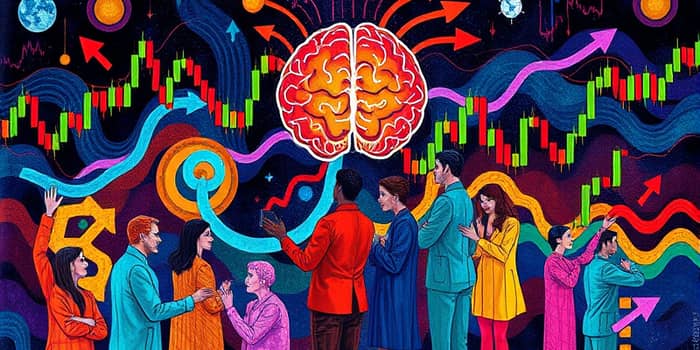
In the unpredictable world of finance, traditional models often fall short of explaining why markets behave contrary to rational expectations. This article delves into the fascinating realm of behavioral economics, where cognitive biases and emotions play starring roles.
Introduction to Behavioral Economics
Behavioral economics challenges the notion that individuals always make logically optimal choices. Instead, it reveals that humans are systematically irrational in predictable ways, influenced by biases, emotions, and mental shortcuts.
This field stands in stark contrast to classic theories like the Efficient Market Hypothesis (EMH), which assume that markets reflect all available information and that actors behave rationally at all times.
Key Principles and Foundational Concepts
Several core ideas underpin behavioral economics, each shedding light on why real-world decisions often diverge from textbook predictions.
- Bounded Rationality: Individuals have limited cognitive capacity, leading to satisficing rather than optimizing choices.
- Heuristics: Mental shortcuts or rules of thumb simplify complex decisions but can cause systematic errors.
- Emotional Decision-Making: Feelings such as fear and excitement frequently override purely logical analysis.
- Irrationality: Persistent deviations from rational choice models are often predictable and measurable.
Major Behavioral Biases and Market Impact
Psychologists Daniel Kahneman and Amos Tversky pioneered the study of biases that shape financial behavior. Key biases include:
- Loss Aversion: People feel losses about twice as intensely as gains, leading to risk-averse or risk-seeking behaviors depending on context.
- Overconfidence: Investors overestimate their forecasting ability, resulting in excessive trading and risk underestimation.
- Herd Behavior: Imitation of others amplifies market booms and busts, from dot-com highs to crypto frenzies.
- Anchoring Bias: Decisions latch onto initial reference points, even when irrelevant.
- Confirmation Bias: Investors seek information that aligns with their beliefs, ignoring contrary evidence.
- Disposition Effect: The tendency to hold losers too long and sell winners too quickly.
Market Anomalies: Evidence of Irrational Markets
Economic anomalies are patterns in asset prices that contradict the idea of fully efficient markets. Their persistence highlights the influence of human psychology.
Other documented puzzles include the Equity Premium Puzzle, where stocks outperform risk-free assets by around 6% annually—far more than rational models predict.
Psychological Theories Underpinning Market Behavior
Under the hood, behavioral economics draws from several influential psychological frameworks:
- Prospect Theory: People evaluate outcomes as gains or losses relative to a reference point rather than absolute wealth changes.
- Mental Accounting: Investors mentally segregate resources, often leading to suboptimal use of available capital.
- Herding Models: Simple rules can explain how individual decisions cascade into collective market moves, sometimes detached from fundamentals.
- Limits to Arbitrage: Even informed traders face constraints (capital, risk, costs) that prevent immediate correction of mispricings.
Real-World Case Studies and Quantitative Evidence
Concrete episodes illustrate how biases and emotions drive markets off course:
- Dot-Com Bubble (1995–2000): NASDAQ soared on speculative enthusiasm, then plunged ~78% when reality set in.
- 2008 Financial Crisis: Overconfidence in housing markets and complex derivatives fueled unsustainable price gains and a severe global crash.
- GameStop Short Squeeze (2020): Coordinated retail investor actions, amplified by social media, produced price swings unrelated to company fundamentals.
Each case underscores how predictable, systematic deviations from rationality can reshape financial landscapes and generate both massive gains and devastating losses.
Criticisms and Limitations
While compelling, behavioral economics faces critiques:
Data mining bias may inflate the significance of some anomalies. Additionally, the persistence of irrational pricing often reflects practical difficulties in correcting mispricing, such as transaction costs, regulatory constraints, and risk limits.
Moreover, markets are composed of heterogeneous agents. Not everyone behaves irrationally at all times, which complicates blanket statements about collective behavior.
Applying Behavioral Economics
Understanding these insights offers practical benefits:
- For Investors: Self-awareness of biases can improve decision-making and portfolio resilience.
- For Policymakers: Regulatory designs that account for herd behavior and panic can mitigate systemic risks.
- For Behavioral Nudges: Simple design changes—like opt-out retirement plans—can boost savings participation from ~50% to over 90%.
By leveraging mental shortcuts and nudge strategies, financial products and policies can be tailored to align better with actual human behavior.
Ongoing Research and Open Questions
The field continues to evolve. Key questions include:
- Which biases dominate during extreme market phases?
- How do high-frequency and algorithmic trading influence traditional anomalies?
- Can machine learning and AI overcome human behavioral limitations, or will they mirror our biases?
Answers to these questions promise to refine our understanding of markets and guide more robust investment and policy frameworks.
Behavioral economics reveals that markets are not purely driven by cold logic but by the rich tapestry of human psychology. By embracing these insights, investors, regulators, and business leaders can navigate uncertainty with heightened awareness and design solutions that work with, rather than against, our innate tendencies.